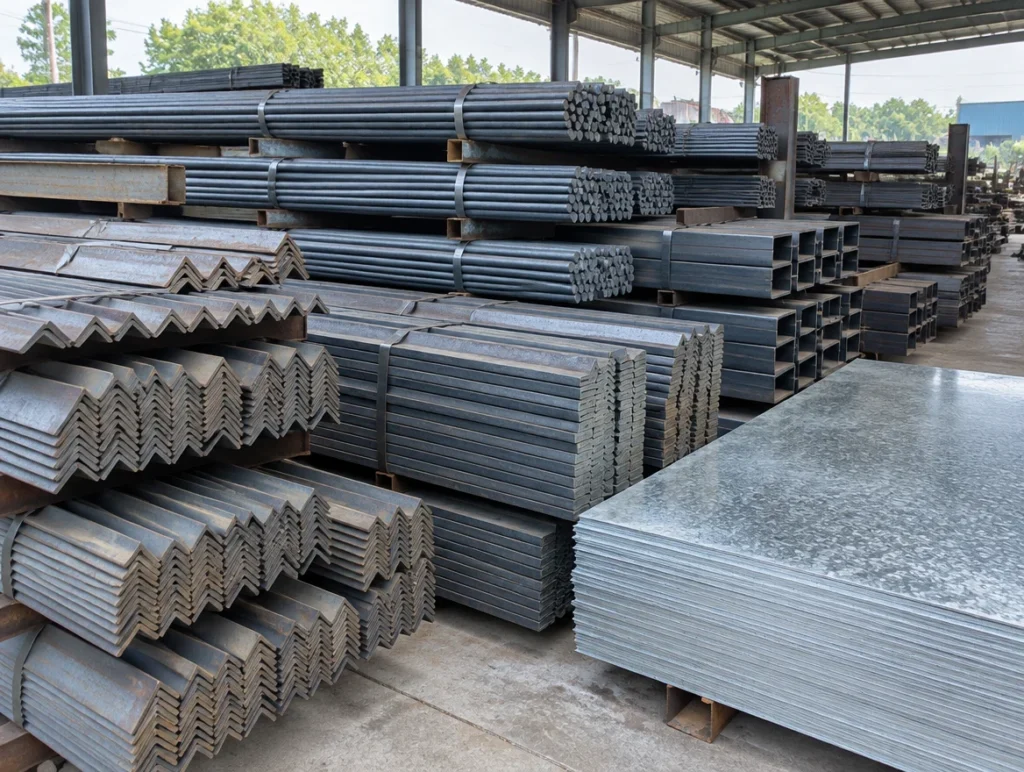
What is MS (mild steel)?
Mild steel is a low-carbon steel, typically with up to about 0.25% carbon. It is ductile and easy to cut, drill, bend and weld, which is why it is the base material for most structural sections, sheets, pipes and fabricated parts. Its main weakness is rust: bare MS corrodes when exposed to moisture unless it is painted, primed or coated.
• MS pipes and tubes (black / ERW)
• MS angles, channels, flats and beams
• MS round and square bars
• MS plates and sheets
What is GI (galvanised iron)?
Despite the name, GI is not pure iron. It is mild steel with a protective zinc coating. Zinc protects the steel in two ways: it acts as a barrier against moisture, and it corrodes first (sacrificial protection), so small scratches do not immediately rust.
Hot-dip galvanised vs pre-galvanised
Hot-dip galvanising (HDG) dips the finished product in molten zinc and gives a thicker coating that suits outdoor use. Pre-galvanising (GP) galvanises the steel strip before it is formed, giving a thinner, smoother coating with less protection at cut edges.
GI vs MS: comparison table
Point
MS
GI
Base material
Low-carbon steel
Same low-carbon steel with zinc coating
Corrosion resistance
Low unless painted
High, thanks to zinc
Strength
Depends on grade and thickness
Essentially the same as the base steel
Welding
Easy
Possible, but needs ventilation and touch-up
Appearance
Dark grey / black, often painted
Silver or matt grey, sometimes spangled
Cost
Lower
Higher (cost of galvanising)
Typical use
Indoor structures, frames, fabrication
Outdoor, wet areas, water lines, roofing, supports
Which is stronger, GI or MS?
A common myth is that one is much stronger than the other. The zinc coating adds corrosion protection, not strength. Strength depends on the steel grade (for example, IS 2062 for structural steel in India) and on the section size and thickness. A GI and an MS section made from the same grade and thickness carry similar loads; the GI one simply lasts longer in a corrosive environment.
When to choose MS
• Indoor structures and machine frames that will be painted
• Parts that need a lot of welding or machining
• Projects where cost is the main constraint and corrosion risk is low
When to choose GI
• Outdoor structures, terraces and roof supports
• Water lines and damp or humid areas
• Cable tray, conduit and pipe supports exposed to weather
• Applications where repainting is difficult
Welding and cutting GI: practical tips
Welding burns off the zinc around the joint and produces zinc fumes, so work in a well-ventilated area with suitable protection. After welding or cutting, apply a zinc-rich (cold galvanising) paint on the weld and cut edges to restore corrosion protection.
GI and MS pipes in India
Steel tubes for water and general purposes are commonly specified under IS 1239 in light, medium and heavy classes, available in both black (MS) and galvanised (GI) finish. Mention the class, nominal bore and finish when you ask for a quotation.
Buying GI and MS products in Bangalore
Hakimi Industrial Suppliers, 2nd floor, 178, Sadar Patrappa Rd (S.P. Road), Bengaluru, handles enquiries for GI / MS products and pipes and pipe fittings. Call or WhatsApp 97397 55252 with your requirement.